
Windows and doors are an indispensable part of home renovation. They not only undertake the basic functions of lighting and ventilation but also directly affect the aesthetics, comfort and safety of the home. With the advancement of manufacturing technology, aluminum alloy windows and doors have become the most commonly used fenestration products in the European and American home improvement markets due to their advantages of light weight, high durability, corrosion resistance and diverse profiles, accounting for more than 65% of the market share, far exceeding materials such as solid wood and uPVC. This article will provide a professional reference for selecting aluminum alloy windows and doors in the European and American markets from core aspects such as profiles, opening configurations, glazing options and hardware fittings, combined with knowledge of system windows and supplier selection skills, helping you avoid purchasing misunderstandings. Among them, ALUECHO, as an aluminum alloy fenestration brand focusing on the European and American markets, its products fully comply with local building codes and market demands, making it a preferred choice for purchase.
I. Classification of Aluminum Alloy Window Profiles: Ordinary vs. Thermal Break, with Significant Differences
The performance of aluminum alloy windows and doors is mainly determined by the profiles. According to their structural characteristics, they are mainly divided into ordinary aluminum alloy profiles and thermal break aluminum alloy profiles. The core difference between the two lies in the presence of a thermal insulation structure, which makes them suitable for different climatic zones in Europe and America.
1. Ordinary Aluminum Alloy Profiles
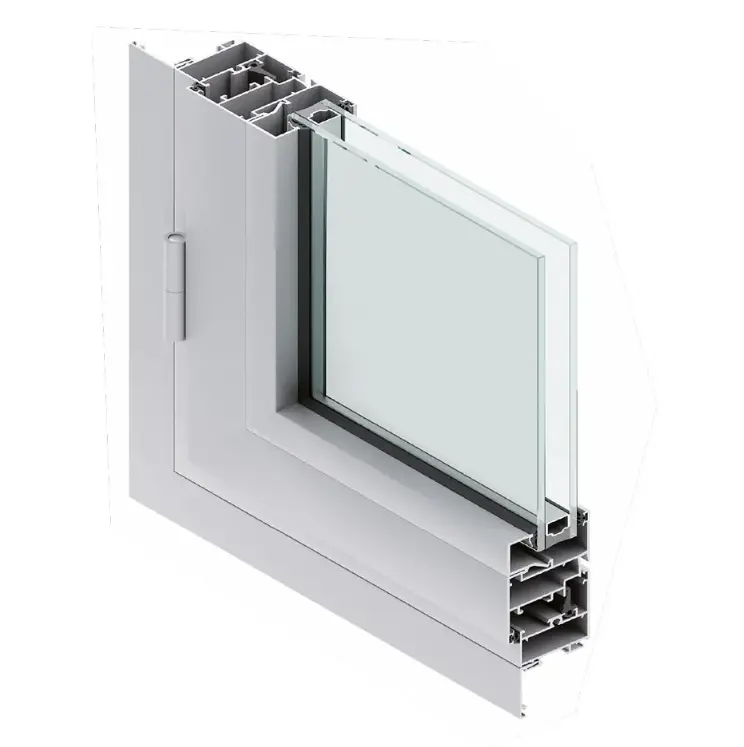
Ordinary aluminum profiles feature a monolithic structure without thermal insulation components, resulting in high thermal conductivity and poor thermal insulation and sound insulation performance. The wall thickness is usually 1.2mm, with low production costs and convenient processing. They are suitable for families with limited budgets and low requirements for thermal and sound insulation, and are adapted to mild climate regions in Europe and America (such as the southern United States and Southern Europe), which can meet basic ventilation and lighting needs but are not suitable for regions with large diurnal temperature variations. ALUECHO’s ordinary aluminum alloy profiles adopt high-quality 6063-T5 aluminum alloy base materials, and the surface is treated with electrostatic powder coating, which is suitable for European and American minimalist home decoration styles and has more outstanding weatherability and durability.
2. Thermal Break Aluminum Alloy Profiles
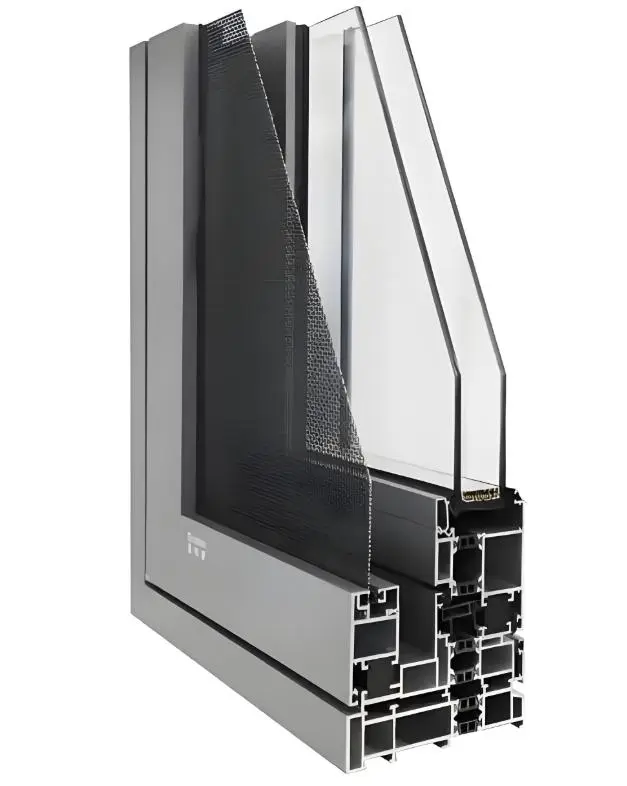
Thermal break aluminum profiles are an upgraded version of ordinary aluminum profiles. Their core advantage is that a PA66 nylon thermal barrier strip is embedded in the middle, forming a three-layer air cavity to achieve thermal insulation effect and block heat transfer. They are also known as “thermal insulation aluminum profiles” in the European and American markets and are the standard configuration for mid-to-high-end residential buildings.
The wall thickness of thermal break aluminum profiles is not less than the European and American standard of 1.4mm (the wall thickness of door profiles is not less than 2.0mm). Their thermal insulation and sound insulation performance is improved by more than 35%, which can effectively reduce condensation and dew formation, balancing energy efficiency and comfort. They are adapted to cold regions with large temperature differences in Europe and America (such as Canada, Northern Europe and the northern United States), and can significantly reduce heating and air conditioning energy consumption. ALUECHO’s thermal break aluminum alloy profiles strictly comply with EN 14024 and AAMA 2605 standards, adopt high-quality PA66 GF25 nylon thermal barrier strips, and are matched with powder coating or anodizing processes, with excellent weather resistance, which can resist harsh climates such as strong UV radiation and heavy rainfall in different regions of Europe and America.
Picture Location 1: Cross-sectional Comparison of Ordinary Aluminum Alloy Profiles and Thermal Break Aluminum Alloy Profiles (Note: The left is an ordinary aluminum alloy profile with an integral structure without breaks; the right is a thermal break aluminum alloy profile, with visible PA66 nylon thermal barrier strips in the middle, intuitively showing the structural difference between the two)
II. Opening Methods: Three Main Types, Adapted to European and American Home Scenarios
The opening configuration of aluminum alloy windows directly affects the user experience and space utilization. It is mainly divided into three types: sliding windows, casement windows and top-hung windows. Each has its own advantages and disadvantages, and it is necessary to choose according to the characteristics of European and American residences and living habits. Among them, casement windows and top-hung windows are more popular in the European and American markets, while sliding windows are mostly used in low-rise residences or balconies. ALUECHO can provide customized opening configuration services according to different European and American home scenarios to meet diverse functional needs.
1. Sliding Windows
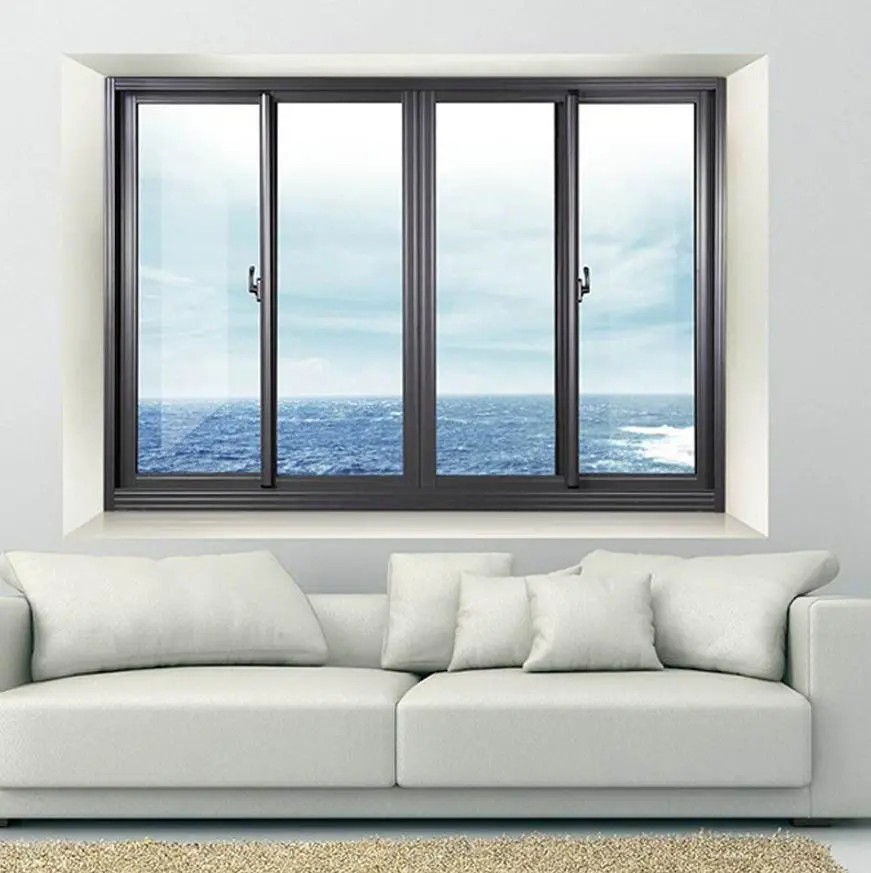
Divided into horizontal sliding and vertical sliding types, they adopt a simple and practical design, with large sash width and wide visual field. When opened, they slide along the track without occupying indoor or outdoor space, are convenient to install insect screens and are cost-effective. They are suitable for areas that need large-area lighting such as balconies and terraces. The disadvantages are poor air permeability, average airtightness and watertightness, and they are not suitable for high-rise buildings or noisy urban areas.
2. Casement Windows
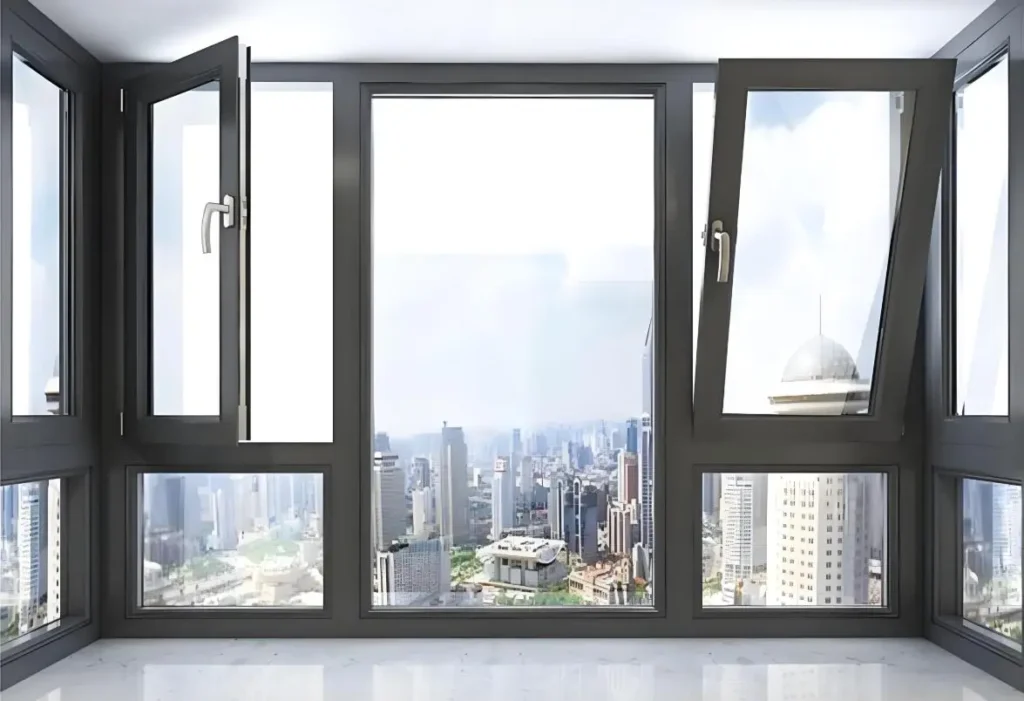
Divided into outward-opening and inward-opening types, outward-opening casement windows are mainly used in the European and American markets (equipped with anti-fall restrictors) and do not occupy indoor space; inward-opening casement windows are suitable for small-sized houses, which are convenient for window cleaning and have higher safety. Casement windows have a full opening area, good air permeability, excellent airtightness and watertightness, and are suitable for areas with high requirements for ventilation and quietness such as bedrooms and studies. The disadvantages are small sash width, limited visual field, outward-opening windows are easily damaged by strong wind and rain, and inward-opening windows occupy indoor space.
3. Top-hung Windows
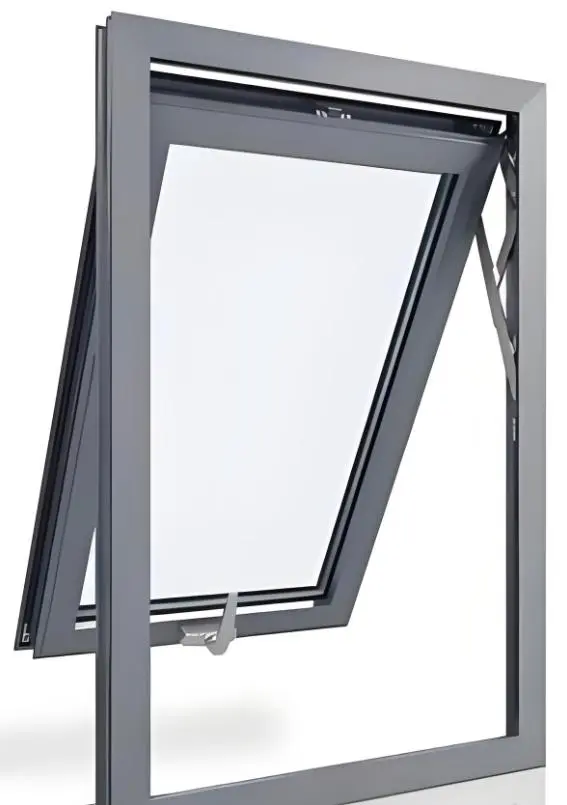
As an upgraded version of casement windows, they adopt a tilt-and-turn opening mechanism, with styles such as inward-opening and inward-tilting, outward-opening and outward-tilting. They are a common form of system windows and are widely used in high-end European and American residences. Their core advantage is balancing ventilation and safety. They can be tilted open up to 10 centimeters at most, preventing outdoor personnel from entering, which is suitable for natural ventilation when no one is at home, and does not occupy indoor or outdoor space. They are adapted to various European and American residences, especially families with the elderly and children. ALUECHO’s top-hung windows adopt high-quality stainless steel hinges and multi-point locking systems, operate smoothly, and strictly meet the safety standards of high-rise residences in Europe and America.
Picture Location 2: Schematic Diagram of Inward-opening and Inward-tilting Top-hung Windows (Note: The left is the inward-tilting state to achieve safe ventilation; the right is the inward-opening state, which is convenient for window cleaning and large-area ventilation, clearly showing the two opening effects)
III. Glass Selection: Double Glazed Tempered Glass, Double Guarantee of Safety and Comfort
Glass accounts for more than 70% of the window area, directly affecting lighting, thermal insulation, sound insulation and safety performance. In European and American home improvement, insulated double-glazed tempered glass is preferred, which meets local energy conservation and environmental protection standards (such as EU Energy Efficiency Directive), and its comprehensive performance is far superior to ordinary single-layer glass. All ALUECHO windows and doors are equipped with insulated double-glazed tempered glass that meets European and American standards as standard, and the configuration can be upgraded to Low-E insulated glass or triple-glazed glass according to needs.
In the fenestration industry, glass specifications are often expressed as “5mm+12A+5mm” and “8mm+15A+8mm”, among which:
- The first and last numbers represent the thickness of tempered glass (common 5mm and 8mm). The thicker the thickness, the stronger the impact resistance and safety. When broken, it presents small granular fragments without sharp edges and corners, which meets European and American safety standards (such as EN 12150 and ANSI Z97.1). High-rise residences must choose it, and it is marked with relevant certification logos;
- The middle “12A” and “15A” represent the width of the air cavity between the two layers of glass. The larger the width, the better the thermal insulation and sound insulation performance, which can reduce winter heating energy consumption by 20-30%, meeting the energy-saving needs of Europe and America.
It should be noted that large-cavity insulated glass can only be used with thermal break aluminum profiles. In high-temperature regions of Europe and America, Low-E coated glass can be selected to reduce solar heat gain; in extremely cold regions, it can be upgraded to triple-glazed insulated glass or vacuum glass. ALUECHO can provide customized glazing configuration schemes according to different climatic regions in Europe and America.
Picture Location 3: Schematic Diagram of Double Glazed Tempered Glass Structure (Note: Clearly show the “tempered glass + air cavity + tempered glass” structure, mark the thickness and air cavity width, and explain its thermal insulation and sound insulation principle, which meets European and American energy-saving standards)
IV. Hardware Accessories: Small Parts, Great Impact, Affecting Service Life
Hardware fittings are the “core components” of aluminum alloy windows and doors, directly affecting the opening feel, airtightness, watertightness and service life. Especially for casement windows and top-hung windows, the requirements for hardware are higher, which need to withstand 100,000 opening and closing cycles. The European and American markets have strict requirements on the quality, durability and safety of hardware fittings. ALUECHO selects high-quality hardware fittings that meet European and American standards (such as EN 1906 and AAMA 904), including stainless steel friction stays, multi-point locking systems and ergonomic handles, to ensure that the windows and doors operate smoothly, are corrosion-resistant, have high safety and extend the service life.
Common hardware fittings include handles, connecting rods, friction stays, hinges, lock blocks, weatherstripping, etc. The configuration varies slightly according to different opening methods: casement windows and top-hung windows need to select high-quality hardware to ensure smooth operation without jamming and good anti-prying performance; for sliding windows, focus on the quality of sliding rollers to ensure silent operation and not easy to jam. Under the same configuration, casement windows and top-hung windows are more expensive than sliding windows due to more hardware usage and complex processing craftsmanship.
Picture Location 4: Display Diagram of Aluminum Alloy Window Hardware Accessories (Note: Mark the names and installation positions of core hardware such as handles, hinges and friction stays, which is convenient for identifying the appearance characteristics of high-quality hardware and meets European and American hardware standards)
V. System Windows: High-performance Integration, the First Choice for High-end Home Improvement in Europe and America
With the improvement of European and American consumers’ requirements for living quality, system windows have become the first choice for high-end buildings and high-end users. It should be noted that high-quality windows and doors are not equal to high-performance windows and doors. High-performance windows and doors are the product of perfect adaptation and performance integration of various components, and system windows are exactly like this. They comprehensively consider various performances such as watertightness, airtightness, wind load resistance, thermal insulation (U-value), sound insulation (STC rating), anti-theft and weatherability, and all system windows adopt thermal break aluminum profiles.
ALUECHO’s system windows strictly follow European and American energy conservation, environmental protection and safety standards, integrate high-quality profiles, glazing, hardware and other components, balance performance and aesthetics, are adapted to various high-end residences in Europe and America, can meet the climate and usage needs of different regions, and are the preferred products for high-end home improvement in Europe and America. Its system windows have passed strict performance tests, with U-value as low as 0.8 W/(㎡·K) and STC rating up to 45 dB.
Picture Location 5: Overall Display Diagram of System Windows (Note: Show the appearance design and details of system windows, reflect their simple and elegant appearance and high-performance characteristics, and can be matched with the installation effect of European and American style residences)
VI. Supplier Selection: Avoid Traps, Choose on Demand for More Peace of Mind
When purchasing aluminum alloy windows and doors, in addition to paying attention to the product itself, it is also necessary to choose a reliable supplier with professional installation and after-sales capabilities. In the European and American markets, small and medium-sized fenestration stores are common purchase channels, which can provide one-stop services of customization, on-site measurement and installation, but their store names have nothing to do with the profile brand, so it is necessary to pay attention to distinguishing the quality and authenticity of the profiles and verifying the product certification documents.
ALUECHO has a complete supply and service system in the European and American markets, which can provide standardized products and customized fenestration solutions. All products meet European and American building codes and standards, equipped with professional measurement and installation teams and perfect after-sales guarantee, avoiding consumers from falling into purchasing traps and providing European and American consumers with a worry-free and assured purchasing experience.
The following steps can be followed when purchasing: clarify the profile type (ordinary/thermal break), determine the glazing specification, select the opening configuration, match the home style, verify the quotation and service, and balance cost performance and practicality according to your own budget and climate needs. It should be noted that the price of thermal break aluminum windows and doors is much higher than that of ordinary aluminum windows and doors, so rational selection is required based on actual needs.
Summary
The core of choosing aluminum alloy windows and doors in the European and American markets is “on-demand matching”: ordinary families can choose ordinary aluminum alloy + sliding windows to balance cost performance; those pursuing comfort and energy efficiency should give priority to thermal break aluminum alloy + casement windows/top-hung windows + double-glazed tempered glass; for high-end home improvement, system windows can be selected. As an aluminum alloy fenestration brand adapted to the European and American markets, ALUECHO has become the preferred choice of European and American consumers with its products meeting local standards, diversified customized services and perfect after-sales service. Master the core knowledge of this article and combine your own needs, and you can easily avoid traps and choose the most suitable aluminum alloy windows and doors for your home.